
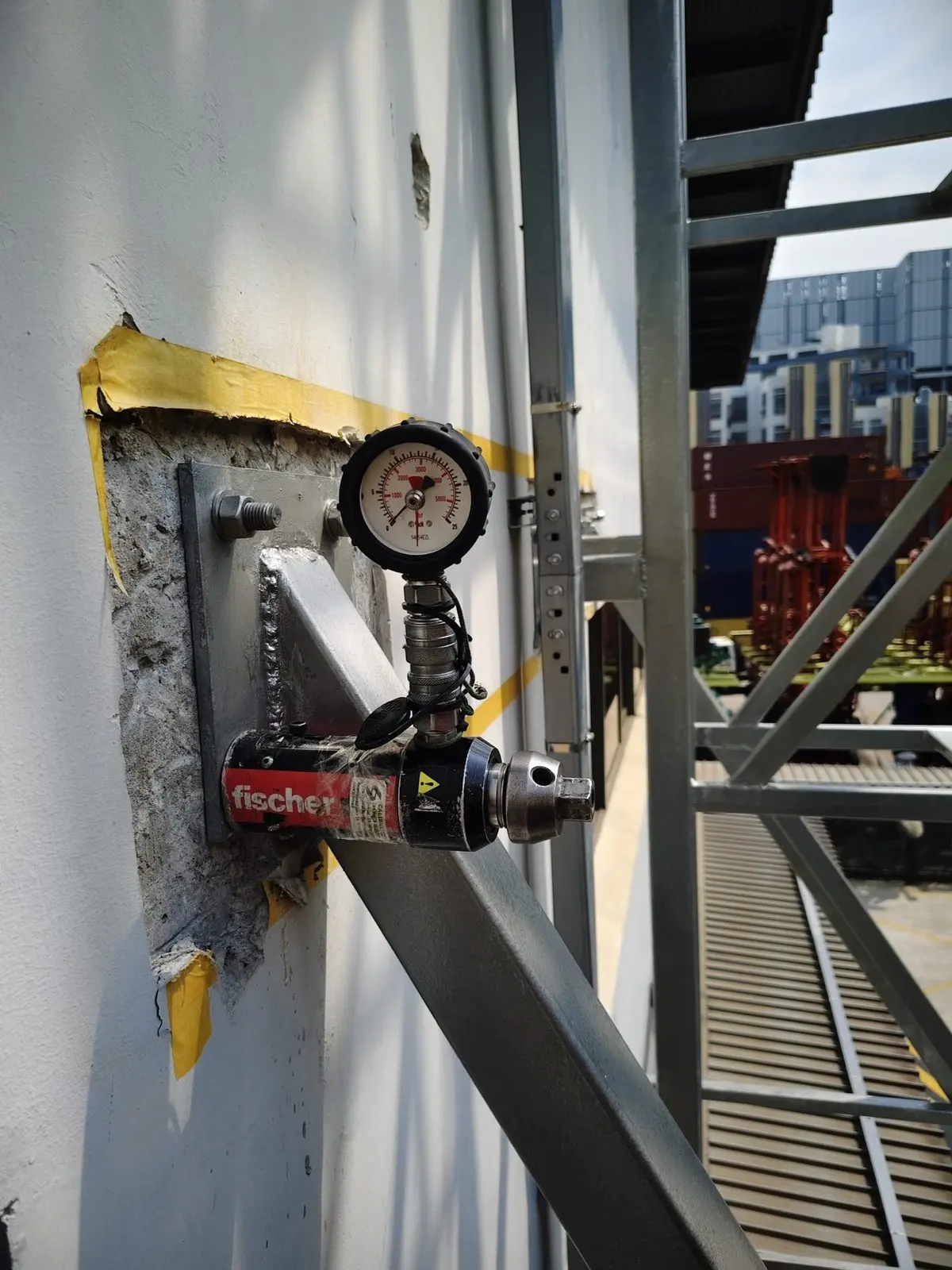
A contractor-side technical reference for Singapore cat ladders, wall anchors, steel fixings and access metalwork — final selection always sits with the project engineer or QP.
---
1. Choosing the Right Concrete Anchor for the Job
Anchor selection is one of the highest-leverage decisions on any metal-works package. The same M16 bolt, used incorrectly, can give you a 30 kN tension capacity in one substrate and pull out at 3 kN in another. The wrong choice quietly affects:
- Load capacity — design tension (NRd) and shear (VRd) under EN 1992-4.
- Service life — coating, base material and substrate condition decide whether the anchor lasts 5 years or 50.
- Seismic performance — only anchors with C1 or C2 ratings are permitted in the cracked, cyclic-load case.
- Fire resistance — fire-rated anchorage is required for life-safety paths and structural fixings to escape routes.
- Installed cost — chemical anchors take longer per hole; mechanical anchors are faster but limited in substrate.
This guide compares four widely specified fischer fastener systems for cracked and uncracked concrete: FIS EM Plus, FIS V Plus, FAZ II Plus and FBN II. It is written for contractors specifying cat ladders, handrails, facade brackets, steel supports and other access metalwork — not as a substitute for a manufacturer datasheet or a project-specific calculation.
> Important: Final anchor selection, load calculation, embedment depth, spacing, edge distance, substrate condition and installation method must be verified by the project engineer or appointed Qualified Person (QP), the product supplier, and the relevant approval documents (ETA, ICC-ES, manufacturer technical guide) for the actual site. The figures below summarise the manufacturer ETA documents supplied as project reference for this article — confirm the current version with fischer or its authorised distributor before specification.
---
2. The Four fischer Bolt Systems at a Glance
| Feature | FIS EM Plus | FIS V Plus | FAZ II Plus | FBN II |
|---|---|---|---|---|
| Anchor type | Pure epoxy injection mortar | Vinyl ester hybrid injection mortar | Torque-controlled expansion bolt | Torque-controlled expansion bolt |
| ETA reference | ETA-17/0979 | ETA-20/0603 | ETA-19/0520 | ETA-07/0211 |
| Concrete state | Cracked & uncracked | Cracked & uncracked | Cracked & uncracked | Uncracked only |
| Concrete strength range | C20/25 – C50/60 | C20/25 – C50/60 | C20/25 – C50/60 | C20/25 – C50/60 |
| Seismic rating (per ETA) | C1 / C2 | C1 / C2 | C1 / C2 | Not assessed |
| Drilling methods | Hammer, hollow-bit, diamond, water-filled holes | Hammer, hollow-bit | Hammer, hollow-bit; diamond (non-seismic) | Hammer drilling |
| Post-installed rebar | Yes — heavy structural | Limited (per ETA) | No | No |
| Best applications | Heavy structural fixings, post-installed rebar, long-life infrastructure | Universal chemical anchor for concrete and masonry | Heavy-duty fixing in cracked concrete | Standard-duty fixing in uncracked concrete |
The table is a summary only. Permitted embedment depths (hef), edge distances (cmin), spacing (smin), characteristic resistances (NRk, VRk) and partial factors must be read from the actual ETA at the embedment depth and concrete grade you are using.
---
3. fischer FIS EM Plus — Pure Epoxy Heavyweight
fischer FIS EM Plus product page →
FIS EM Plus is fischer's pure-epoxy injection mortar, assessed under ETA-17/0979. It is the system to specify when you need maximum capacity in concrete, the longest service life, or post-installed rebar connections.
Where it is typically used:
- Heavy structural fixings — column base plates, transfer brackets, bridge furniture.
- Post-installed rebar starter bars for slab extensions, lift-shaft retrofits and structural strengthening.
- Long-life infrastructure where 50-year design life is required.
- Wet or water-filled holes where vinyl ester chemistry would be compromised.
Why it is chosen:
- Cracked-concrete approval (Option 1) with C1 and C2 seismic categories per the ETA.
- Compatible with hammer drilling, hollow drill bits, diamond drilling and water-filled holes.
- Higher characteristic bond stresses than typical hybrid mortars at deep embedment.
- Long working time on hot-day pours where short-set hybrids would gel before installation.
Trade-offs:
- Slower full-cure than vinyl ester hybrids — cure tables in the ETA must be respected before applying torque.
- Cartridge cost is higher than FIS V Plus on a per-anchor basis.
- Not the right product for small, low-load fixings where a mechanical anchor is sufficient.
For cat ladder anchor bolt sets onto critical lift-shaft walls, or for heavy steel supports onto an ageing reinforced-concrete frame, FIS EM Plus is often the conservative choice in wall embedment engineering Singapore practice, subject to QP review.
---
4. fischer FIS V Plus — Universal Vinyl Ester Hybrid
fischer FIS V Plus product page →
FIS V Plus is fischer's vinyl ester hybrid injection mortar, assessed under ETA-20/0603. It is the everyday workhorse chemical anchor — versatile across concrete and (with a sleeve) masonry, faster cure than epoxy, and suitable for cracked concrete.
Where it is typically used:
- Universal concrete fixings where a chemical anchor is required.
- Masonry anchorage with FIS H perforated sleeves for hollow brick, hollow blocks and AAC (per separate ETA).
- Cat ladder and handrail bracket fixings on RC walls and slabs.
- Facade brackets, signage frames, plant pads and roof-mounted equipment.
Why it is chosen:
- ETA Option 1 (cracked concrete) approval; C1 and C2 seismic categories per the ETA.
- Faster gel and cure than pure epoxy — useful on programme-driven sites.
- Single-cartridge mortar covers a wide range of substrates with the right sleeve.
- Lower temperature limit and broad compatibility with standard threaded studs.
Trade-offs:
- Generally lower bond stress than FIS EM Plus at the same embedment in the same concrete.
- Not assessed for the same range of post-installed rebar applications as FIS EM Plus.
- Hollow-drill / diamond / water-filled-hole compatibility is narrower than EM Plus — read the ETA.
For most chemical anchor vs mechanical anchor decisions in Singapore metalwork, FIS V Plus is the common chemical baseline when a wedge anchor is not appropriate (cracked concrete, edge-distance constraints, or close anchor spacing).
---
5. fischer FAZ II Plus — High-Performance Through-Bolt
FAZ II Plus is fischer's torque-controlled expansion bolt, assessed under ETA-19/0520. The product family includes the standard zinc-plated FAZ II Plus, the FAZ II Plus R in stainless A4 (1.4401), and FAZ II Plus HCR in highly corrosion-resistant grade for severe environments. It is designed specifically for cracked concrete anchor applications with seismic ratings, and is one of fischer's primary structural mechanical anchors.
Where it is typically used:
- Heavy-duty structural fixings into reinforced concrete where speed of installation matters.
- Cat ladder anchor bolt sets where the bracket sees pull-out and shear.
- Curtain-wall fixings, lift guide brackets, MEP equipment supports, plant skids.
- Through-bolt connections to slabs, columns and shear walls.
Why it is chosen:
- ETA-19/0520 covers cracked and uncracked concrete (Option 1).
- C1 and C2 seismic categories per the ETA — important for any structural fixing on a building that must resist cyclic loads.
- Compatible with hammer drilling, hollow-bit drilling and (for non-seismic applications) diamond-drilled holes.
- Through-installation (the bolt is set through the steel fixture) saves a measurement step on site.
- Stainless (R) and HCR variants extend service life in coastal, splash, pool or high-chloride environments.
Trade-offs:
- Like all expansion anchors, edge distance and anchor spacing requirements are larger than for chemical anchors at the same embedment.
- Not suitable for hollow substrates, AAC or weakly bonded blockwork — concrete only.
- Diamond-drilled hole permission is conditional on non-seismic load case in the ETA — confirm before specifying.
FAZ II Plus is often the right answer when speed and structural capacity matter together — for example, retrofitting a long run of cat-ladder brackets onto a service-core wall where chemical-anchor cure time would push the programme.
---
6. fischer FBN II — Standard-Duty Bolt Anchor
FBN II is fischer's standard wedge-type bolt anchor, assessed under ETA-07/0211. It is approved for uncracked concrete only and is the workhorse for general light- to medium-duty fixings.
Where it is typically used:
- Non-structural fixings onto uncracked concrete: timber framing, light shelving, signage, partitions.
- Mechanical and electrical fastenings where the load is not safety-critical.
- Temporary works where the engineer has confirmed the substrate is uncracked under the design case.
Why it is chosen:
- Lowest installed cost of the four systems.
- Fast hammer-drill installation, no cure time.
- Available in standard zinc-plated and stainless R variants.
Trade-offs:
- Not approved for cracked concrete. Most cat-ladder and structural fixings on Singapore RC walls must be assumed cracked under design loads, which rules FBN II out by default.
- Not seismically assessed — do not specify FBN II where the ETA cracked-concrete and seismic protocols would normally apply.
- Edge-distance, spacing and embedment limits in the ETA are stringent; small concrete sections often disqualify it.
In practice, on metalwork packages we treat FBN II as a non-structural choice. It belongs on light-duty fixings into known-uncracked concrete, not on cat ladder anchor bolt sets, structural brackets or anything that interacts with seismic or fire requirements.
---
7. Mechanical vs Chemical Anchors — Which Family to Choose?
The four products above split into two families:
- Mechanical (torque-controlled expansion): FAZ II Plus and FBN II.
- Chemical (injection mortar): FIS EM Plus and FIS V Plus.
A simplified decision logic for Singapore metalwork:
- Is the concrete cracked under design load?
- Default YES for cat ladder brackets, handrails on perimeter walls, structural fixings on tension faces of slabs and beams. Rules out FBN II.
- Is the anchor in the seismic load path of a structural element?
- If yes, you need C1 or C2 — FIS EM Plus, FIS V Plus or FAZ II Plus.
- Is the spacing tight or the edge distance small?
- Chemical anchors typically allow tighter spacing and smaller edge distances at the same embedment than expansion anchors — favour FIS V Plus or FIS EM Plus.
- Is there a post-installed rebar requirement?
- FIS EM Plus is the heavy-duty chemical for rebar dowelling.
- Is speed the dominant constraint?
- FAZ II Plus is one of the quicker-to-install cracked-concrete-rated structural anchors when the substrate, edge distance and seismic case permit.
- Is the substrate hollow or AAC?
- None of the four are first-line; switch product family (e.g. FIS V Plus + FIS H sleeve, or AAC-specific anchor per its own ETA).
This decision logic is a starting point only. In practice, the QP runs the EN 1992-4 verification at the actual hef, edge distance, spacing and concrete grade, and selects the product whose ETA approved anchor values pass with adequate margin.
---
8. Bolt Grade and Embedment Considerations
Anchor capacity is governed by the weaker of three failure modes in EN 1992-4:
- Steel failure of the bolt (tension and shear) — driven by M16 bolt grade (e.g. 8.8, A4-70).
- Pull-out / combined pull-out and concrete cone — driven by the chemical or mechanical interaction with the concrete.
- Concrete cone / splitting / edge / pry-out — driven by hef, edge distance, spacing and the concrete grade.
For a typical cat-ladder bracket on a 200 mm RC wall:
- M12 8.8 is common for light brackets at hef 80–110 mm; check the product ETA for the actual hef permitted.
- M16 8.8 or M16 A4-70 is common for heavier brackets at hef 110–170 mm.
- A4-70 stainless (FAZ II Plus R, FBN II R, threaded studs in FIS V Plus / FIS EM Plus) is preferred wherever the bracket itself is stainless or aluminium, to avoid galvanic mismatches.
- HCR grade is for splash, pool, marine, swimming-pool plant rooms and persistently wet environments where A4 alone may pit over the design life.
The bolt grade decision is bound up with the access metalwork Singapore material — stainless cat ladders should usually run stainless studs, galvanised mild steel ladders can run zinc-plated bolts in dry interiors and stainless or HCR in humid or external exposure.
---
9. Design and Compliance Checklist for Specifiers
Before the supplier or QP signs off the anchor specification, a working checklist:
- Substrate confirmed — concrete grade (C20/25, C30/37, C40/50…), reinforcement layout, cover and condition.
- Crack state assumed — cracked unless the engineer can demonstrate otherwise; default to cracked for any structural / safety-critical metalwork.
- Seismic case — if the structure is in a seismic load path, anchors must be C1 or C2 per the ETA.
- Fire case — if the metalwork is on an escape route, fire-rated anchorage data must be referenced (separate fire test certificate; not all anchors carry a fire rating at every embedment).
- Edge distance and spacing — measured against the ETA minimums at the chosen hef, including any reduction factors.
- Hole condition — dry, wet or water-filled; only certain mortars are approved for water-filled or wet holes.
- Drilling method — hammer, hollow-bit, diamond — checked against the ETA permission for the chosen product.
- Installation torque — the calibrated torque value from the ETA must be applied with a properly calibrated wrench; over-torque on a chemical anchor strips the bond.
- Inspection regime — pull-out test, torque check, or visual record per project specification.
- Documentation — final selection with the ETA reference, hef, edge distance, spacing, installed torque and inspection record on the QP-endorsed drawing.
This checklist intentionally does not produce a number. It produces a paper trail. Wall embedment engineering Singapore practice depends on that paper trail — the calculation, the ETA reference, the inspection record — to demonstrate that the anchor specification is defensible if it is ever queried.
---
10. FAQ
Is fischer ETA approval the same as Singapore approval? No. ETA stands for European Technical Assessment and is issued by an EOTA member body — not by a Singapore authority. Singapore practice typically references EN 1992-4 and ETA-rated anchors via the QP's design and the BCA submission, but ETA is not a Singapore-specific approval. The project engineer is responsible for confirming that the chosen anchor is acceptable under the actual project specification.
Is FBN II ever acceptable for a cat ladder? Only if the QP can demonstrate the concrete is uncracked at ULS at every anchor location, the load case is non-seismic, and the safety case allows it. In most Singapore cat-ladder retrofits we treat FBN II as a non-structural choice and default to FAZ II Plus, FIS V Plus or FIS EM Plus.
Can FAZ II Plus be installed in diamond-drilled holes? Per ETA-19/0520, diamond-drilled holes are permitted for non-seismic applications subject to the conditions in the ETA. For seismic cases, hammer or hollow-bit drilling is required. Confirm with the current ETA before specifying.
What is the practical difference between FIS EM Plus and FIS V Plus? Both are ETA approved anchor chemical mortars suitable for cracked concrete with C1/C2 seismic ratings. FIS EM Plus is a pure-epoxy mortar with broader hole-condition compatibility (including water-filled holes), longer working time and full post-installed rebar approval. FIS V Plus is a vinyl ester hybrid with faster cure and broader masonry compatibility via sleeves. FIS EM Plus is typically specified for heavy structural and rebar applications; FIS V Plus is the everyday chemical.
Do I need a stainless anchor for an indoor cat ladder? Not always. Indoor, dry-air environments often allow zinc-plated steel anchors. Indoor humid plant rooms, washrooms, kitchens, basements with water ingress, and any external or semi-external exposure should default to A4 stainless (R variant) or HCR for chloride-heavy environments. The bolt grade also has to match the bracket material to avoid galvanic corrosion.
How does this relate to Hilti? Hilti has comparable products (HIT-RE 500, HIT-HY 200, HST3, HSA) with their own ETAs. We've covered the Hilti vs fischer family-by-family comparison in Hilti vs Fischer wall anchors — bolt sizing for Singapore metal works.
---
11. Conclusion — A Simple Decision Tree
For most Singapore metalwork packages — cat ladders, handrails, facade brackets, steel supports, roof-access metalwork — the practical decision tree looks like:
- Heavy structural / post-installed rebar / wet hole / 50-year life → FIS EM Plus
- Universal cracked-concrete chemical anchor / mixed substrate / programme-driven → FIS V Plus
- Cracked-concrete structural through-bolt / fast install / seismic → FAZ II Plus (with R or HCR variant for corrosion exposure)
- Light non-structural / known-uncracked concrete / dry interior → FBN II
In every case, the actual values — hef, edge distance, spacing, characteristic resistance, installed torque, fire and seismic categories — must be taken from the current ETA for the actual product version, applied to the actual concrete grade, and signed off by the project engineer or QP.
For project context on how anchor specification interacts with the metalwork side, see our related articles on cat ladder wall embedment, Hilti vs Fischer bolt sizing and 18-metre cat ladder design. For our build capability, see cat ladders and access metalwork, stainless steel fabrication and custom metal works.
---
Sources and reference documents
- fischer FIS EM Plus product page — fischer-international.com
- fischer FIS V Plus product page — fischer-international.com
- fischer FBN II product page — fischer-international.com
- ETA-17/0979 (FIS EM Plus), ETA-20/0603 (FIS V Plus), ETA-19/0520 (FAZ II Plus), ETA-07/0211 (FBN II) — project reference documents supplied for this article. Confirm the current published version with fischer or its authorised distributor before specification.
- EN 1992-4:2018 — Eurocode 2: Design of concrete structures — Part 4: Design of fastenings for use in concrete.
- BS 8539:2012 — Code of practice for the selection and installation of post-installed anchors in concrete and masonry.
MetalSingapore.sg is a Singapore metal-works contractor. We are not the manufacturer, distributor or official representative of fischer, and this article is a contractor-side technical summary, not a fischer marketing publication. Final anchor selection sits with the project engineer or appointed QP.