
> A material-selection reference for Singapore engineers, fabricators and Qualified Persons (QPs) — covering EN 10025 structural steel grades, stainless steel SS304/SS316 and galvanised mild steel for handrails, cat ladders, platforms, fencing and structural metalwork.
Specifying the wrong steel grade costs Singapore projects rework, RFIs and re-submissions. S275JR or S355JR? SS304 or SS316? Galvanised mild steel or aluminium? The right answer changes with every handrail, platform, cat ladder and ramp — and getting it wrong shows up at audit. This page consolidates the EN 10025 steel grades Singapore specifiers actually use, side by side with stainless steel and galvanised mild steel, with the working rules our metal fabrication workshop applies on structural steel comparison for everyday handrail, gate, fencing and cat-ladder work.
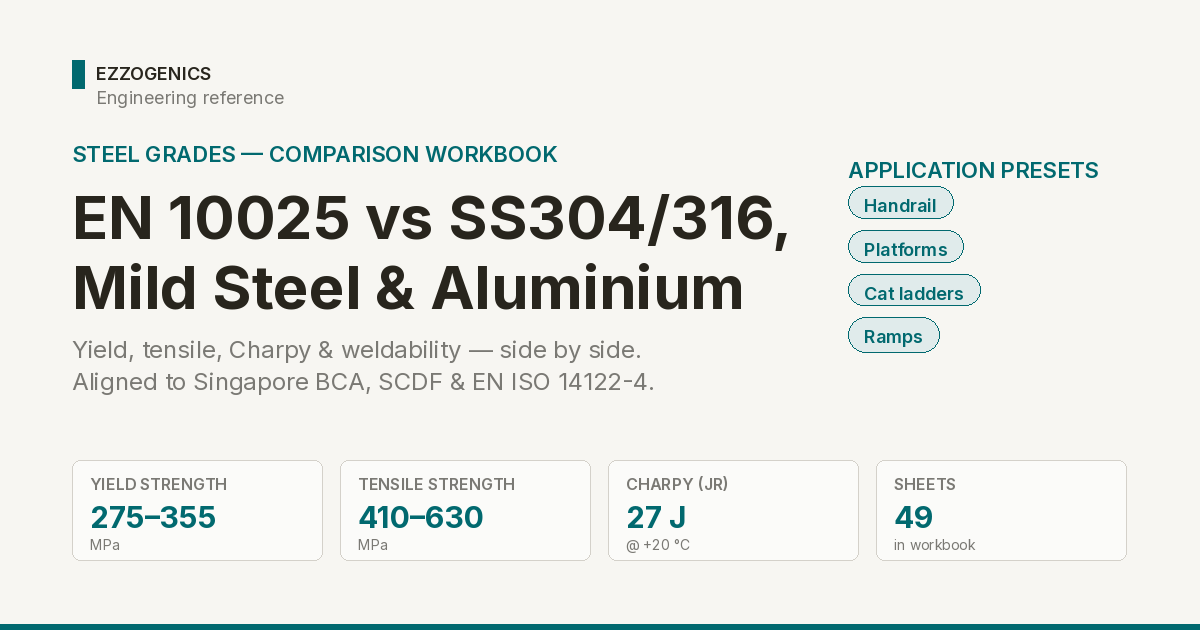
!EN 10025 vs SS304/316, Mild Steel & Aluminium — comparison workbook
---
1. The grades that actually appear on Singapore drawings
Most non-exotic structural and architectural metalwork in Singapore is specified from a short list of grades:
| Family | Common grades | Where they appear |
|---|---|---|
| **EN 10025-2 non-alloy structural steel** | **S235JR, S275JR, S355JR, S355J0, S355J2** | Beams, columns, RHS/SHS frames, **cat ladder** stiles and rungs, platform structure, gates, fencing posts |
| **EN 10088 austenitic stainless steel** | **SS304 (1.4301), SS316 (1.4401)** | Architectural **handrails**, balustrades, marine and pool-deck access, food-grade fixtures, coastal cat ladders |
| **Galvanised mild steel (HDG to BS EN ISO 1461)** | Substrate typically S275JR or S355JR | External railings, fencing, cat ladders, trellis, light structural frames in covered or sheltered exposure |
| **Aluminium 6063-T6 / 6061-T6** | EN AW-6063 / 6061 | Lightweight portable cat ladders, walkways and roof-access metalwork where weight matters |
The mild steel grades S275JR and S355JR ship in nearly every fabrication enquiry. The decision between them is not climatic — both are fine in Singapore — it is structural and economic.
---
2. S275JR vs S355JR — which grade for which scope
Both are non-alloy structural steels under EN 10025-2 with the same impact-test class (JR = 27 J at +20 °C). For Singapore's tropical climate either subgrade is adequate. The decision is structural and economic:
- S275JR — minimum yield 275 MPa, tensile 410–560 MPa. Slightly more ductile, generally available ex-stock in Singapore. Good default for handrails, light platforms, secondary framing, fencing posts and most architectural metalwork.
- S355JR — minimum yield 355 MPa, tensile 470–630 MPa. About 29 % more yield strength for roughly 3 % extra cost, so thinner sections can be used and weight saved on long spans, beams and load-bearing frames.
Rule of thumb our stainless steel fabrication Singapore workshop applies to mild steel scopes: start with S275JR and only upgrade to S355JR when deflection, span, or section size drives the design. For a typical 18 m vertical cat ladder the stiles are usually S275JR; for a long-span platform or rooftop walkway frame with deflection limits, S355JR pays back its premium quickly.
---
3. SS304 vs SS316 — when marine grade is actually justified
Both are austenitic stainless steels, but SS316 adds 2–3 % molybdenum, which materially improves resistance to chloride pitting and crevice corrosion. In Singapore that translates into a clear handrail material selection rule:
- SS304 — sheltered indoor and protected outdoor: stairwells, internal handrails, equipment skids in dry plant rooms, balcony rails set back from sea spray.
- SS316 — within roughly 1 km of the coast, on rooftops exposed to salt-laden winds, in chlorinated environments (swimming-pool decks, water-treatment plants), or for any cat ladder, handrail or platform on offshore, port, jetty or marine-facing facilities such as Tuas, Jurong Island and Pasir Panjang.
The cost premium for SS316 is typically 15–25 % over SS304, but lifecycle cost is lower because pitting on SS304 in salt-laden air can start within 2–5 years and is not cosmetically recoverable. Our blog Handrail material selection — SS304 vs mild steel for Singapore covers the handrail choice in more depth, and Lifespan of galvanised MS vs SS304 vs SS316 compares expected service life.
---
4. Galvanised mild steel — when HDG is the right answer
For external railings, fencing, trellis, gates and cat ladders in non-coastal, non-chlorinated environments, galvanised mild steel is often the most cost-effective specification. Hot-dip galvanising to BS EN ISO 1461 typically deposits 70–85 µm of zinc, giving 20–40 years of protection in mild urban exposure (ISO 9223 categories C2–C3). Repair welding voids the coating locally, so the rule we follow is: weld first, fabricate fully, then galvanise — never the other way round.
Galvanised mild steel is not a substitute for stainless steel near the coast or on rooftops with persistent salt-laden wind. The sacrificial zinc layer corrodes faster in C4–C5 categories, and once it is exhausted, the steel substrate rusts at the rate of any uncoated mild steel. See Cat ladder material selection — aluminium vs SS304 vs galvanised mild steel for the working comparison we use on cat ladder material selection.
---
5. Charpy V-notch — do you ever need J0 or J2 in Singapore?
Almost never on temperature grounds alone. The Charpy V-notch impact subgrades are tested at:
- JR — 27 J at +20 °C
- J0 — 27 J at 0 °C
- J2 — 27 J at −20 °C
Singapore's lowest recorded temperature is 19.0 °C (Paya Lebar, 14 Feb 1989) and steel members rarely sit below ambient. JR is therefore adequate for the vast majority of building, façade and access-equipment work in Singapore.
Specify J0 or J2 only when:
- The member sits in a refrigerated or cryogenic plant room (cold storage, LNG handling, food-processing freezers).
- The structure is fabricated for export to a colder climate or for an offshore project with a low-temperature design specification.
- The QP's structural calculation explicitly calls up J0/J2 for fracture-toughness reasons (heavy welded sections > 40 mm, fatigue-critical members, or BS EN 1993-1-10 driven selection).
Paying the J2 premium "to be safe" on a normal Singapore building is wasted money — about 10 % over JR with no service benefit.
---
6. Strength-to-weight, weldability and the practical short-list
When the spec is open and the QP allows alternatives, our steel fabrication Singapore workshop typically benchmarks four candidate materials side by side:
| Property | S275JR | S355JR | SS304 | SS316 | Galv. MS (S275JR sub.) | Al 6063-T6 |
|---|---|---|---|---|---|---|
| Yield (MPa, min) | 275 | 355 | 205 | 205 | 275 | 215 |
| Tensile (MPa) | 410–560 | 470–630 | 515–720 | 515–690 | 410–560 | 240 |
| Density (kg/m³) | 7,850 | 7,850 | 8,000 | 8,000 | 7,850 | 2,700 |
| Strength-to-weight indicator | mid | high | low–mid | low–mid | mid | mid (for weight) |
| Weldability (CEV) | excellent | excellent | requires inert-gas process and stainless filler | requires inert-gas process and stainless filler | as substrate; coating must be repaired locally | requires AC-TIG with cleaned filler |
| Coastal / chloride exposure | poor | poor | fair | good | poor (zinc only) | good (oxide layer) |
| Architectural finish | painted only | painted only | mirror, brushed, satin | mirror, brushed, satin | matte zinc, can paint over | mill, anodised |
The clean working rule for structural steel comparison on Singapore architectural metalwork:
- Default to S275JR mild steel for internal and well-protected scopes.
- Step up to S355JR when span, deflection or weight makes thinner sections worth the small price.
- Use SS304 for visible handrails and architectural elements indoors and in sheltered outdoor spots.
- Use SS316 within ~1 km of the coast, on exposed rooftops, around pools, and on any salt-water-facing access metalwork.
- Use galvanised mild steel for cost-driven external railings, fencing and cat ladders away from the coast.
- Use aluminium 6063 only when weight or portability genuinely drives the design.
---
7. Application presets — handrails, platforms, cat ladders, ramps
Aligned to EN ISO 14122-4 for fixed access ladders and to the relevant Singapore codes for handrails and platforms, the typical specification we quote is:
- Architectural handrails (interior, public) — SS304 tube 50.8 × 1.5 mm or 38 mm × 1.5 mm with welded SS304 stanchions; satin No. 4 finish. Mild steel acceptable if powder-coated and sheltered.
- Architectural handrails (coastal / rooftop) — SS316 equivalents to the above, satin or brushed.
- Cat ladders (internal building, dry) — S275JR mild steel, hot-dip galvanised, stiles 60 × 12 mm flat bar, rungs Ø 20 mm at 250–300 mm pitch, safety hoop above 3 m (informational only — final design and embedment to be confirmed by the appointed QP). See 18 m cat ladder design considerations for the detailed engineering walkthrough.
- Cat ladders (rooftop solar / coastal) — SS316 stiles and rungs, or SS304 on inland rooftops where exposure is mild. See SCDF, solar PV and roof-access cat ladder design considerations.
- Walkway platforms — S355JR primary frame for span-driven sections, S275JR for short spans, hot-dip galvanised. Grating typically 25 × 3 mm bearing bar at 30 mm pitch, GMS or SS316 for coastal scope.
- Loading ramps — S275JR or S355JR substrate depending on span, anti-slip plate top, mechanical fixings (Hilti / Fischer) sized per anchor manufacturer's ETA data and the QP's calculation. See Hilti vs Fischer wall anchors — bolt sizing for Singapore.
These presets are starting points, not final specifications. Final grade, section size and connection design must be confirmed by the appointed Qualified Person, especially for any work that interacts with structural members, façades, fire-rated construction or means of escape.
---
8. Floor loading, BCA and SCDF — where steel selection meets imposed loads
A platform, mezzanine or work-at-height access scope is only as safe as the slab and supporting structure beneath it. Floor-loading numbers in Singapore come from BCA (via the Eurocodes), JTC (for industrial estates) and SCDF (for fire-specific loads such as storey shelters, fire-engine accessways and refuge floors). All three apply in parallel and the most onerous governs.
For a metal fabrication scope this matters when:
- A mezzanine or storage platform is being added — imposed UDL and point load must be re-checked.
- A rooftop cat ladder lands on a slab that may also have to take fire-engine wheel loads or solar-PV equipment.
- Any structural metalwork is being bolted into existing slabs or walls — the host element capacity is as much a factor as the new steel.
We've published a dedicated article — Floor loading in Singapore — who sets the numbers, and where SCDF actually fits in — that walks through the BCA / JTC / SCDF split in detail and clears up the common myth that SCDF requires 7.5 kN/m². It does not.
---
9. Downloadable: EN 10025 Steel Grades Comparison workbook
For specifiers who want the underlying data on their own desk, we publish a 49-sheet EN 10025 structural steel grades comparison workbook benchmarking S275JR, S355JR and S355J2 against stainless steel SS304 / SS316, galvanised mild steel and aluminium 6063 — with side-by-side yield strength, tensile strength, Charpy V-notch impact toughness (JR / J0 / J2), weldability (CEV) and strength-to-weight ratios.
It also includes built-in multi-word search across 2,217 indexed rows, dedicated stainless steel and mild steel stock catalogues, plus one-click application-compare presets for handrails, work-at-height platforms, cat ladders and ramps.
Download the EN 10025 Steel Grades Comparison workbook (.xlsx)
The workbook is provided as a reference tool. Output values, supplier rates and section availability change over time and must be re-checked against the latest standards and supplier datasheets before being used on a live project. Anchor capacities and structural calculations are subject to the QP's review and the relevant ETA / design-code rules.
---
10. Need help specifying the right grade?
Sizing a handrail, platform, cat ladder or ramp for a Singapore project? Send us your span, load and exposure and we will come back with a recommended grade, section and BCA / SCDF-aligned specification, plus an itemised quote.
Request a quote from MetalSingapore.sg — we cover custom metal works, stainless steel fabrication, metal gates, metal railings, fencing and grilles, cat ladders and access metalwork and outdoor trellis and structural metalwork across Singapore.
---
Frequently asked questions
S275JR vs S355JR — which should I specify for a Singapore project?
Both are non-alloy structural steels under EN 10025-2 with the same impact-test class (JR = 27 J at +20 °C), so for Singapore's tropical climate either subgrade is adequate. The decision is structural and economic. Start with S275JR for handrails, fencing, light platforms and most architectural metalwork. Upgrade to S355JR only when span, deflection or section size makes thinner / lighter members worth the roughly 3 % cost premium for ~29 % more yield strength.
SS304 or SS316 for Singapore — when do I really need marine grade?
Use SS304 for sheltered indoor and protected outdoor: internal stairwells, balcony rails set back from spray, equipment in dry plant rooms. Use SS316 within roughly 1 km of the coast, on rooftops exposed to salt-laden winds, in chlorinated environments (pool decks, water-treatment plants) and on any cat ladder, handrail or platform on marine-facing facilities such as Tuas, Jurong Island or Pasir Panjang. The 15–25 % cost premium for SS316 is normally recouped through avoided pitting and replacement.
Do I ever need J0 or J2 grades in Singapore's climate?
Almost never on temperature grounds alone. JR (27 J at +20 °C) is adequate for the vast majority of Singapore building and access-equipment work. Specify J0 or J2 only when the member sits in a refrigerated or cryogenic plant room, when the structure is fabricated for export to a colder climate, or when the QP's calculation explicitly calls up J0 or J2 (heavy welded sections > 40 mm, fatigue-critical members, BS EN 1993-1-10 selection). Paying the J2 premium "to be safe" on a normal Singapore building is wasted money.
Can MetalSingapore.sg fabricate to a specific EN 10025 grade and traceability requirement?
Yes. We work to drawings or a written specification and can supply mill certificates (3.1 to EN 10204) for the material delivered, where the supplier provides them. Welder qualifications, weld procedure specifications and inspection scope are agreed in writing per project. Any structural metalwork that interacts with primary structure, façade, fire-rated construction or means of escape is fabricated to the QP's design and the relevant Singapore code; we do not self-certify structural design.
---
This article is a material-selection reference. Final grade, section size, anchor and connection design must be confirmed by the appointed Qualified Person and verified against the latest editions of the relevant Singapore Standards, Eurocodes and authority requirements.